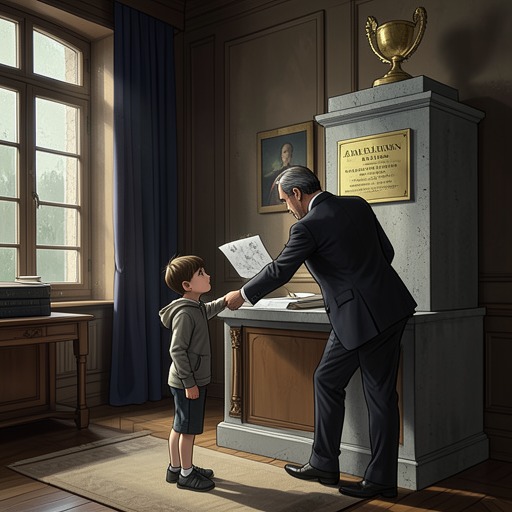
Adi scholarship report in Yug
Serious MenAdi scholarship report in Yug is the printed announcement that ten-year-old Aditya Mani has been selected for a science scholarship in Geneva. In the novel, its importance lies not only in what it claims but in what Ayyan Mani does with it: he buys every copy, brings the news into his home and his son’s school, and lets a private construction acquire the authority of public print.
The article and its claims
The report appears in Yug, a Marathi daily sold from a temporary plywood stand at the end of a lane near BDD Chawl. Ayyan approaches the stand anxiously, searches through its papers, and finally finds the item in a corner. Its headline, A Special Boy, announces the story in the language of exceptional promise. The placement matters: the news is a small newspaper snippet, not a prominent feature, yet Ayyan recognizes its power at once.
The item says that Aditya Mani, aged ten and in the sixth standard at St Andrew’s School, has been chosen by the Department for Scientific Education and Excellence of Switzerland to spend a month in Geneva later that year. It describes a written screening test intended for students under sixteen, taken by more than five hundred students in the twelfth standard, from which Adi was the sole selected candidate. The report presents the contrast between his age and the older candidates as the proof of his remarkable ability. It also supplies him with a public ambition: quoted in the item, the shy boy says, “I want to understand the universe better.”
Ayyan’s circulation of the story
Ayyan buys all ten copies the seller has. The act turns the report from one passing item into a small stock of evidence that can be carried, shown, and repeated. At home, he pushes a copy in front of Oja Mani while she is absorbed in heating milk. She sees Adi’s photograph and switches off the stove; Ayyan is irritated by this ordinary interruption, expecting the paper’s arrival to eclipse domestic routine. Instead, that routine makes the announcement’s entry into family life concrete.
Oja sinks to the floor with the paper, frightened as she reads, then smiles and looks at her sleeping son. Her first question is when he took the test. Ayyan tells her it was two months earlier, on a Sunday, and says he withheld the information because he thought she would fuss. Her response moves quickly from alarm to pride: she cries, calls Adi famous, and wishes the newspaper had printed his full picture, since she thinks he is more beautiful than the photograph. She rubs and pulls his toes to wake him, shows him the report, and watches him look at his own image before falling back onto the pillow. The paper gives Oja a sudden public version of the child she knows at home, while Adi himself shows little interest in the printed acclaim at that moment.
Translation and institutional display
Ayyan carries the report to St Andrew’s School, where he meets Sister Chastity after Adi has run to class. She reads the article but cannot decipher Marathi, despite being able to read Hindi and French. Ayyan translates it for her. The report therefore reaches the school through another act of mediation: its printed authority depends on someone making its language legible to the person who can give it institutional recognition.
Once she understands the story, Sister Chastity says she will put it on the noticeboard. She regrets that the report does not identify the school specifically as St Andrew’s, Worli, because there are many schools called St Andrew’s. That practical concern reveals the difference between a claim about an individual boy and the institutional credit the school hopes to claim from it. Later, Ayyan shows the same newspaper to Oparna Goshmaulik and asks whether she can read Marathi. She studies it with evident curiosity and reacts with disbelief that his boy is a genius, asking whether he will bring Adi to the institute. The clipping thus travels beyond the family and school into Ayyan’s workplace, where the story can acquire further witnesses.
Public promise and social limits
The scholarship report belongs to Ayyan’s fabrication of Adi’s genius, but it gives that fabrication a form that appears to come from outside the household. A printed article, a named selection body, a competitive test, a school affiliation, and a future stay among scientists in Geneva combine to make the claim look verifiable. Its specificity is part of its force: the age of ten, the more than five hundred older candidates, the single selection, and the proposed one-month visit make the story sound like a record rather than a father’s boast. The article does not merely praise Adi; it supplies the details through which others can repeat the praise.
That public promise stands against the social history Ayyan describes to Sister Chastity. He identifies himself as a Dalit, the son of a sweeper, raised in a one-room home, and contrasts that beginning with the advantages and achievements accumulated by Brahmins over centuries. The report’s image of a child crossing into international scientific opportunity can therefore carry a charge beyond parental pride: it offers a striking counter-image to inherited exclusion. Yet the clipping announces an exceptional boy, not a change in the conditions faced by Dalit families. Elsewhere, Ayyan urges that they sell their home and move so their children need not continue living in what he calls a hell. Set beside that desire for ordinary material security, the article’s dazzling promise remains both potent and precarious: it makes one child’s imagined ascent legible without resolving the circumstances from which the family hopes to escape.